
One of the biggest questions people ask when considering this career is simple: how much can an independent auto damage appraiser realistically make?
The short answer is that income varies based on claim volume, territory, workflow, and experience. The longer and more useful answer is that this is a performance-based career. From firsthand experience, I can tell you that the strongest income results usually come from consistency and efficiency rather than flashy shortcuts or unrealistic claim counts.
That is good news for beginners, because it means success is not reserved only for people with decades of experience. It means the more organized, accurate, and repeatable your process becomes, the better your earning potential usually gets.
Typical Income Range for Independent Appraisers
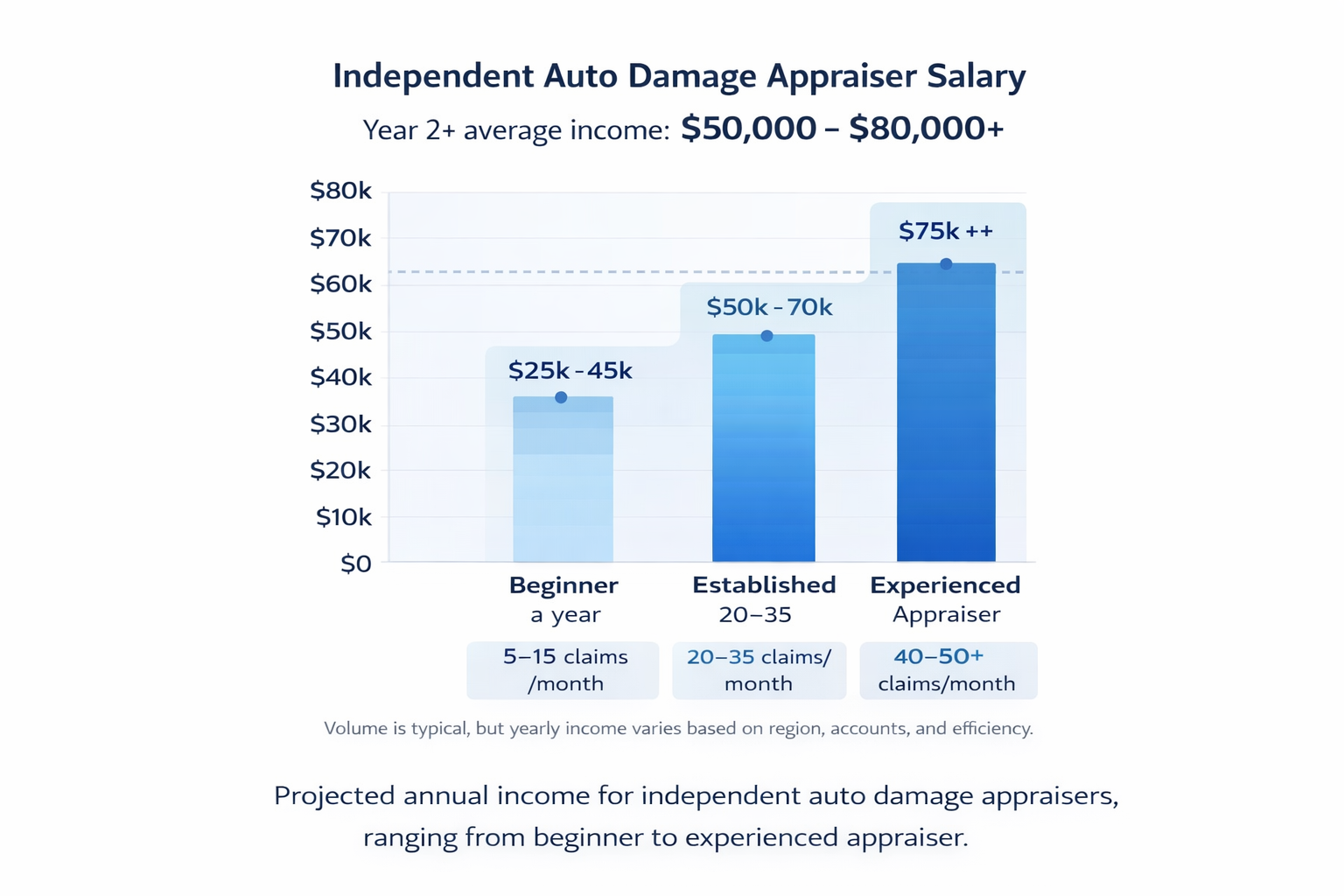
For many people entering the field, a realistic target range in the early years is roughly $50,000 to $80,000 annually. More experienced appraisers who handle stronger volume, work more efficiently, or specialize in more complex areas can earn more than that.
A rough way to think about the income ladder is this:
- Newer appraisers: around $50,000 to $80,000
- Established, efficient appraisers: around $80,000 to $100,000+
- Highly experienced or specialized appraisers: $100,000+ in some situations
These numbers are not fantasy numbers. They come from the reality of claim volume, fee structures, and how many assignments a person can handle cleanly without burying themselves in rework.
How Independent Appraisers Usually Get Paid
Unlike many traditional jobs, independent appraisers are often paid on a per-claim basis instead of earning a flat hourly wage. That means your income is tied directly to the number of assignments you can complete and the type of assignments you handle.
Typical fees can vary, but a practical range often looks something like this:
- Simple claims: roughly $75 to $150
- Standard claims: roughly $150 to $300
- Complex claims: roughly $300 to $500 or more
From real-world experience reviewing workflow and estimate output, the biggest earnings differences usually do not come from chasing only the biggest claims. They come from managing normal, repeatable claim volume effectively. A steady stream of standard claims handled well is often the backbone of dependable income in this field.
A Realistic Early-Career Example
Let’s use a very realistic beginner-to-intermediate example. Say an appraiser averages:
- 8 claims per day
- around $125 average per claim
- 5 working days per week
That can put yearly income in the ballpark of $65,000 to $75,000, depending on actual assignment flow, unpaid downtime, re-inspections, travel efficiency, and how many weeks per year the appraiser is actively working.
This is why so many people find the career appealing. It offers a path to solid earnings without requiring a traditional degree, but it still rewards professional skill and disciplined habits.
What Actually Affects Income the Most
1. Efficiency
The biggest factor is not usually intelligence. It is efficiency. Can you inspect thoroughly without wasting motion? Can you document clearly? Can you write the estimate in a consistent way without constantly rethinking basic steps?
From years of estimate review, I have seen that slower appraisers do not always earn less because they are less capable. Often they earn less because their process is inconsistent. They lose time bouncing between tasks, over-documenting simple claims, or fixing avoidable mistakes later.
2. Claim Volume
Since many independent appraisers are paid per file, volume matters. But volume only helps if quality holds together.
A rough real-world range often looks like this:
- Beginners: 3 to 6 claims per day
- Intermediate appraisers: 6 to 10 claims per day
- Experienced appraisers: 10 to 15 claims per day
Trying to jump straight to high volume before your process is ready usually backfires. It creates supplements, poor documentation, confusion, and unnecessary stress. The better approach is to build volume on top of accuracy, not instead of it.
3. Territory and Assignment Density
Your local market matters. Dense urban areas may provide higher assignment counts with less windshield time. More rural areas may involve longer travel and fewer daily inspections, even when the appraiser is working hard. Weather events can also temporarily increase assignment volume in some regions.
This is why two equally capable appraisers may have very different daily numbers depending on geography alone.
4. Estimate Quality
This is one of the most overlooked parts of income. Poor estimate quality creates delays, rework, supplement loops, and credibility problems. Appraisers who consistently submit clean, supportable work tend to build stronger relationships and keep work moving. That matters financially.
In real-world review situations, some of the biggest money leaks come from:
- missed damage
- weak notes
- poor photo support
- illogical repair decisions
- inconsistent estimate structure
Those are not just technical problems. They are income problems.
5. Specialization
As appraisers gain experience, some increase income by expanding into higher-value or more specialized work. This can include areas like:
- electric vehicles
- ADAS-related damage considerations
- commercial vehicles
- total loss review work
- diminished value-related assignments
Not everyone needs to specialize immediately, but specialization can become a strong income lever later.
Common Mistakes That Hold Income Down
New appraisers often assume low income means there is not enough work. In many cases, that is not the real issue. The bigger issue is that avoidable mistakes are reducing efficiency and making each file take longer than necessary.
Common problems include:
- poor routing between inspections
- overcomplicating simple files
- missing damage and creating extra supplement work
- weak organization during the day
- taking too long in estimating software because the workflow is not yet structured
From my experience, strong earning appraisers are usually not magicians. They are people who have trimmed waste out of the process.
How to Increase Income Over Time
The best way to grow income in this field is to improve the quality and efficiency of your process step by step.
That usually means:
- using a repeatable inspection routine
- taking cleaner photo sets
- learning one estimating platform well
- building a consistent estimate structure
- batching similar tasks when possible
- reviewing your own work before submission
Those habits do not just make you look more professional. They directly affect how many assignments you can handle and how much rework you avoid. Better workflow usually leads to better income.
What Makes This Career Attractive
For many people, this field hits a rare balance. It offers a practical, skill-based path into a profession with legitimate earnings, and it does so without requiring the traditional college route. It also gives people who are organized and self-directed a chance to benefit directly from becoming better at the work.
That does not mean it is easy money. It is not. But it is real opportunity for people willing to become competent, efficient, and dependable.
Final Thoughts
A realistic salary for an independent auto damage appraiser depends on claim volume, territory, experience, and workflow quality. For many beginners, earning roughly $50,000 to $80,000 is a realistic early target. As efficiency, confidence, and assignment handling improve, income can rise meaningfully from there.
From someone who has spent many years in the industry and in multiple roles, my honest view is that this profession rewards people who build strong habits. If you become organized, accurate, and consistent, your earning potential usually follows. In this field, process is not just about doing the job well. Process is a big part of how you get paid.